Wind turbine robots are being built to inspect tall towers, check blades, and reach surfaces that are costly or risky for people to access. The next step is harder: a robot must find a defect, explain what it found, and help fix the problem without creating another safety risk.
Quick read
- Climbing robots can keep sensors close to towers and blades during inspection.
- Drones cover large areas quickly, but close surface checks still need careful control.
- Repair work will need better autonomy, clearer evidence, and safe human control.
Inspection comes before repair
Most wind turbine robot work starts with inspection. Cameras, thermal sensors, and other tools can check blades, towers, and support structures without sending a person to every surface.
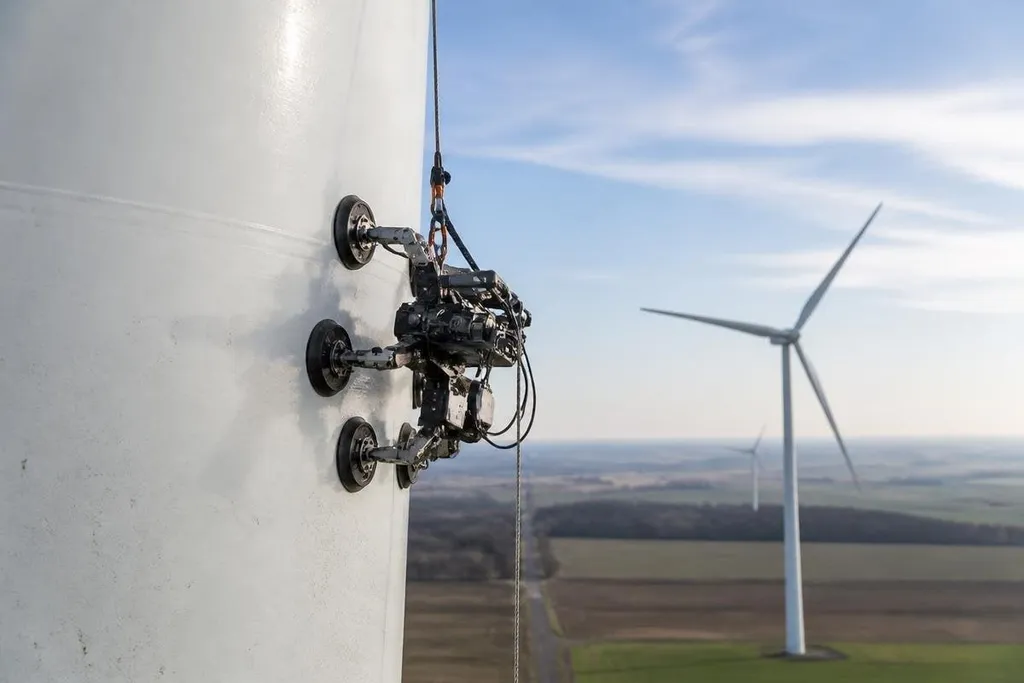
A drone can view a blade from several angles while flying near the turbine. A climbing robot takes a different approach: wheels, magnets, suction, or another grip system keep it against the surface while it moves along a set path.
Those designs answer different problems. A drone can cover an area quickly, while a climbing robot can keep a sensor close to a crack, worn coating, or loose part. Neither design removes the need for a trained person to review the result.
That review matters because a picture alone may not show how deep a defect is or whether it needs repair. The useful output is a clear record of the location, the type of damage, and the reason for the proposed next step.
The robot needs a reliable grip
Wind turbine surfaces are not uniform. A tower may be curved steel, while a blade has changing shape, painted sections, seams, and edges. Rain, ice, dirt, and wind can also change how a robot holds position.
A robot that works on a clean test surface may behave differently on a wet blade. Its control system must keep the robot stable while its sensors collect usable images or measurements. It also needs a safe response when traction drops or a motor stops.
That makes recovery part of the design, not a feature added later. The operator needs to know where the robot is, what it can still do, and how to bring it back without sending someone into the same hazard the robot was meant to avoid.
Autonomy must earn trust
The word autonomous covers several levels of machine control. A robot may follow a planned route, hold its position while a person directs it, or choose where to inspect next. Those are different tasks with different risks.
For wind turbine work, the useful path will likely combine automatic movement with human approval. The robot can keep a steady distance from a surface, record sensor data, and flag an area for review. A person can then decide whether the robot should scan again, stop, or move to another section.
A blade scan that marks a defect still leaves the repair team needing its depth and exact location. Robot24.com can tie those measurements to the robot, turbine, test date, and field result before you judge if the system is ready for repair work.
The open problem is repair. A robot may spot a damaged blade, but applying material to the right depth and shape is harder than taking a picture. A repair tool also adds weight, force, cables, and new ways to lose contact with the turbine.
What buyers should ask next
A wind farm operator comparing these systems needs more than a short inspection video. Use this checklist before treating a robot as ready for regular work:
- Surface range: Which tower and blade materials can it handle?
- Weather limits: What wind, rain, temperature, and ice conditions stop the job?
- Sensor proof: Can the system show defect location, image quality, and repeat scans?
- Recovery plan: What happens after a power loss, grip failure, or lost signal?
- Human control: Can an operator stop or redirect the robot at any point?
- Repair evidence: Has the maker shown a finished repair, not only inspection footage?
The answers should appear in test records, operating limits, and maintenance procedures. A polished demonstration does not show how the system behaves after hours on a dirty, moving surface.
I'd wait before treating repair robots as ready for wide use unless the maker can show repeatable work on real turbine surfaces. Inspection systems have a clearer job and a simpler path to useful records, but repair still has to prove that the robot can work safely when conditions change.
The next proof point is not a faster video. It is a complete job record showing where a defect was found, how the robot handled the surface, and what happened after the operator approved the next step.